
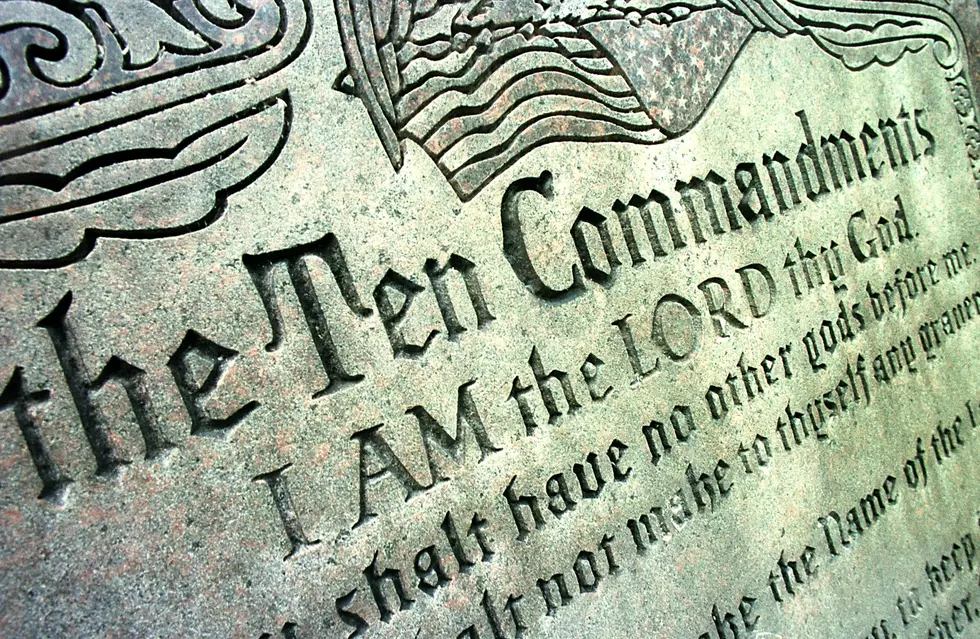
Federal Court Clears the Way for Ten Commandments in Every Louisiana Classroom
LAFAYETTE, La. (KPEL News) — Louisiana public schools got the green light Friday to begin posting the Ten Commandments in every classroom after the full U.S. Fifth Circuit Court of Appeals vacated the preliminary injunction that had been blocking the state’s law.
The en banc ruling, meaning all active judges on the court weighed in rather than a three-judge panel, tossed the injunction that the ACLU had won at the district court level. The majority held that legal challenges to House Bill 71 were premature because how individual school districts display the Commandments hasn’t been determined yet, making it impossible to properly evaluate the constitutional questions.

Attorney General Liz Murrill, who has been defending the law in court, welcomed the decision.
“Don’t kill or steal shouldn’t be controversial,” Murrill said. “My office has issued clear guidance to our public schools on how to comply with the law, and we have created multiple examples of posters demonstrating how it can be applied constitutionally. Louisiana public schools should follow the law.”
What HB 71 Requires
Louisiana’s HB 71 requires public schools to display the Ten Commandments in every classroom on a poster or framed document at least 11 inches by 14 inches. The text must be the central focus of the display and printed in a large, easily readable font. The law also requires a “context statement” describing the historical role of the Ten Commandments in American public education.
Schools may optionally display other foundational documents alongside the Ten Commandments, including the Mayflower Compact, the Declaration of Independence, and the Northwest Ordinance; however, these additions are not required. The law took effect at the start of 2025, at which point Murrill issued compliance guidance and model poster examples to schools across the state.
Why the Court Said Not Yet
The majority of the Fifth Circuit, writing in a per curiam opinion, didn’t rule on whether HB 71 is constitutional. Instead, the en banc court found the case wasn’t ripe for judicial review.
PREVIOUSLY: Federal Court Strikes Down Louisiana's Ten Commandments Law
The court’s reasoning centered on the law’s flexibility. Because HB 71 leaves the specific nature of each display up to individual school boards — allowing them to add materials, choose framing, and determine placement — the court said it couldn’t evaluate the constitutionality of displays it hasn’t actually seen.
“We cannot evaluate ‘how the text is used,’ because we do not yet know — and cannot yet know — how the text will be used,” the majority wrote. Without a concrete factual record of actual classroom displays, the court said it would essentially be guessing rather than judging.
The majority was careful to note that its ruling doesn’t slam the door on future challenges. Parents and advocacy groups can still sue once displays are up and actual implementation can be reviewed in context.
The Dissent Pushed Back Hard
Six judges dissented across two separate opinions, arguing the majority was using a procedural maneuver to sidestep a clear constitutional question.
Judge James Dennis, joined by four colleagues, argued the case was fully ripe because HB 71 specifies exactly what must be displayed — the precise text, minimum size, font requirements, and placement — leaving little to the imagination. The dissenters contended the Supreme Court’s 1980 ruling in Stone v. Graham, which struck down a nearly identical Kentucky law, should control the outcome here.
“Today, the Fifth Circuit deploys ripeness as a calculated stratagem to evade these precedents,” Dennis wrote.
Judge Carolyn Dineen Haynes dissented separately, agreeing that the case was ripe and that the preliminary injunction should have been upheld. Haynes emphasized that the court’s role is to follow what the Supreme Court requires — not to express a personal view on the Ten Commandments themselves.
Judge James Ho concurred with the majority’s outcome but wrote separately to argue the court should have simply upheld the law on the merits, calling the Ten Commandments display fully consistent with the Constitution and the country’s founding traditions.
Plaintiffs Call the Ruling a ‘Game of Constitutional Whack-a-Mole’
The plaintiffs in the case, identified as Roake v. Brumley, are a multifaith group of nine Louisiana families with children in public schools. They are represented by Americans United for Separation of Church and State, the ACLU, the ACLU of Louisiana, and the Freedom From Religion Foundation, with Simpson Thacher & Bartlett LLP serving as pro bono counsel.
SEE ALSO: Clergy, Parents Sue to Block Louisiana's 10 Commandments Law
The organizations issued a joint statement Friday calling the ruling a setback but vowing to continue the fight.
“Today’s ruling is extremely disappointing and would unnecessarily force Louisiana’s public school families into a game of constitutional whack-a-mole in every school district,” the statement read. “Longstanding judicial precedent makes clear that our clients need not submit to the very harms they are seeking to prevent before taking legal action to protect their rights. But this fight isn’t over. We will continue fighting for the religious freedom of Louisiana’s families.”
What This Means for Louisiana Schools
With the injunction gone, Louisiana school districts are no longer legally blocked from implementing HB 71. Murrill’s office had already distributed guidance and model poster designs to schools statewide. Some districts may move quickly; others may wait to see how the legal landscape develops.
This ruling is also significant beyond Louisiana. A parallel challenge to Texas’s similar law — Senate Bill 10 — was consolidated with this case for en banc oral argument. Friday’s ruling sets the tone for how those challenges may proceed in the Fifth Circuit, which covers Louisiana, Texas, and Mississippi.
The ACLU and parent plaintiffs who filed the original suit retain the ability to bring new challenges once displays are actually implemented and a factual record exists.
10 Things Every True South Louisiana Driver Should Keep in Their Car
Gallery Credit: Joe Cunningham
